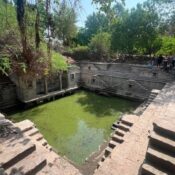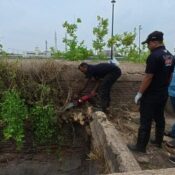
Ahmedabad’s first town-planning scheme grew over this vav completely. The Municipal Corporation later excavated it back out, and then the neighbourhood began tipping waste into it. In June 2026, over three Sundays, Team Ramdoot Restores cleared it again, opposite Uttam Nagar Garden in Maninagar. The work is complete.
The monument
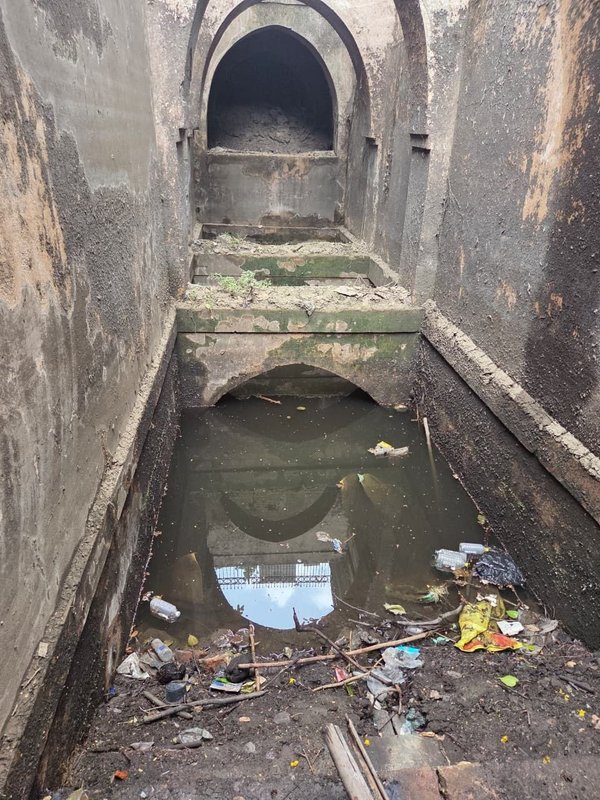
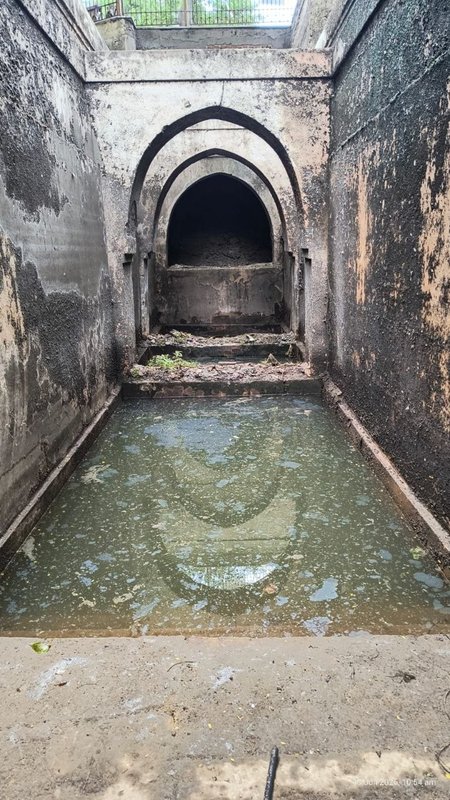
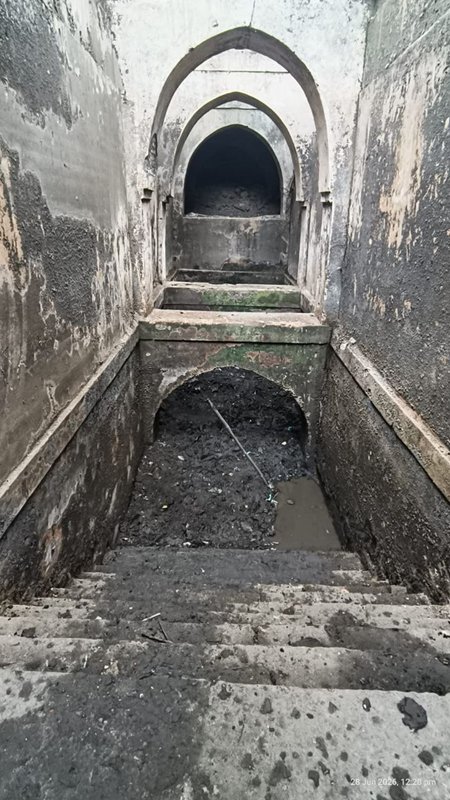
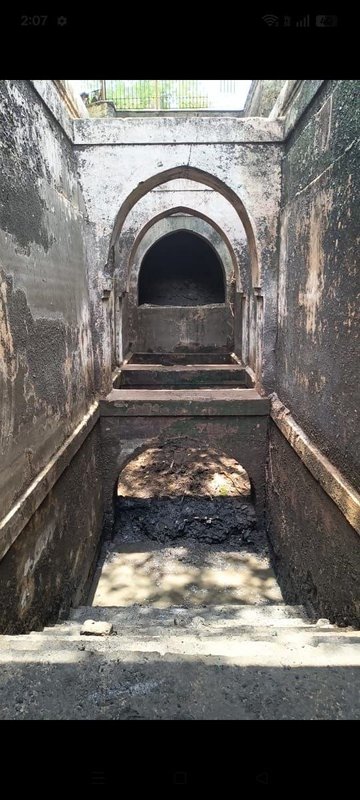
The structure faces west, with two carved toda (ceremonial entrance pillars) flanking the opening. From there the steps descend through one kuta, a covered landing, then two ardh-kuta, the arches that brace the side walls against the pressure of the earth behind them, and on to the well shaft.
It is brick and lime mortar throughout, and the ornament is restrained: diamond patterns cut into the risers and decorative bands above the wall niches. Nothing on the building names a founder or a date. There is no inscription anywhere on it.
Where it stands, and why
Its siting is the argument for what it is. Vavs here were built on the outskirts of settlements, along the roads leading out of them, as water, shade and rest for travellers. They were secular structures, built by merchants as often as by rulers, and open to all. This one belongs to a line of such wells running south-east out of Ahmedabad through Maninagar, Isanpur, Vatva, Aslali and Bareja toward Mehmedabad.
Buried, then recovered, then abandoned
In the twentieth century that outskirt became Maninagar, the first planned settlement outside the walled city, laid out on Seth Maneklal Manilal’s land under a town planning scheme drawn up by Sardar Vallabhbhai Patel. The vav went under it entirely and disappeared from view.
The Municipal Corporation later excavated it and replastered the walls in lime; the vav standing today is that recovery. Then maintenance stopped. Sewage collected in the kutas, the shaft was filled and tarred over as road, and the plot was used as a dumping ground. Only the compound wall kept it from being built on. Measured plans, sections and an isometric drawing exist for this vav. Maintenance did not.
Pumped down, then dug out by hand
The work here was water and silt, not stone. The kutas were dewatered, and the last of the water was bailed out of the channel by bucket before digging. Then the silt bed was cut with spades, filled straight into tubs at the face, and passed up the steps hand to hand, roughly one person per tread. There were no barrows inside the structure. Full tubs were lifted clear of the shaft mouth and swung to the next pair of hands, and bamboo was slung between two people for the heaviest tubs off the bed. No machinery entered the structure and nothing was tipped back into the shaft.
Once the silt was off them, the treads were washed down tub by tub. Growth was cut and bagged along the compound wall and carried out to the road. Household waste was sorted into tubs at the landing rather than shovelled aside, and the upper flight between the two toda was swept. The last pass was brushing the landing under the arch, once the bed was clear.
Water out, silt out, nothing else touched
Every surface is original brick and the Corporation’s lime plaster, uncovered. The landing, the nested arches above it and the step run into the shaft read as one structure again. Every tread from the terrace down to the shaft is walkable, and the diamond-cut risers and niche bands are legible along the side walls.
More than three hundred people across three Sundays
The clearing was run with the Ahmedabad Municipal Corporation, the same body that excavated and replastered the vav years earlier. Volunteers did the lifting, and residents of Daxini Society worked alongside them.
Two Gujarati dailies covered the vav in June 2026, nine days apart. Sandesh, on 15 June, set what the city spends on sanitation against the state of this one structure: a stepwell in a heritage city with no conservation of any kind, its very existence in question. Gujarat Samachar Plus, on 24 June, reported the Sunday shramdaan that cleared it: five hours of work every Sunday, with AMC and state archaeology permission, across three Sundays at Uttam Nagar.
At a glance
- Location: Opposite Uttam Nagar Garden, Maninagar, Ahmedabad
- Recorded as: Ancient Stepwell, Maninagar Ward
- Local name: Veni Doshi ni Vav
- Founder: Unknown, no inscription
- Plan: 1 kuta, 2 ardh-kuta
- Fabric: Brick and lime mortar
- Orientation: West-facing, two toda
- Published record: Joshi 2017 (UMC/AMC)
- Status: Completed, unprotected
- Our work: 3 Sundays, June 2026
- Press: Sandesh, Gujarat Samachar Plus
Water out, silt out, nothing else touched.
Before the clearing