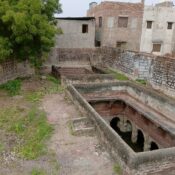
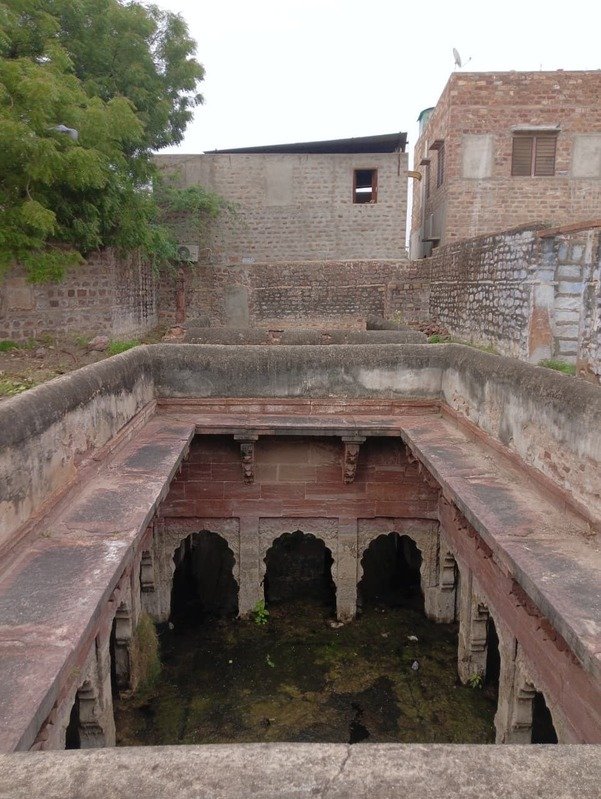
Pachwa Majisa ki Baori sits behind the Pachwa Majisa temple on Kila Road, Jodhpur. Locally it is also called Patal Phod Baori: a queen’s well, sunk so deep that the city named it for piercing the underworld. Two Rajasthan dailies covering the 2026 shramdaan describe it as a two-hundred-year-old heritage structure. It appears on no protected list. The work is complete.
The monument
The site is named for the fifth wife of Maharaja Man Singh of Jodhpur, Pachwa Majisa, the fifth Majisa. The temple raised for her carries her name, and the baori was cut directly behind it.
Maharani Sa came from what is today Pakistan, and brought her family deity with her: a black marble idol of Shri Krishna, Thakurji, installed in the temple alongside a marble Radha Rani. A palace was built for her on the same ground, so that she could live beside the temple and its water. The three were conceived together, and all three still stand.
The name Patal Phod Baori, the well that breaks through to patal, the underworld, comes from the depth to which it was sunk. No inscription has come to light; the account here is the one held on site and in the family memory of the neighbourhood.
A complex built as a single act
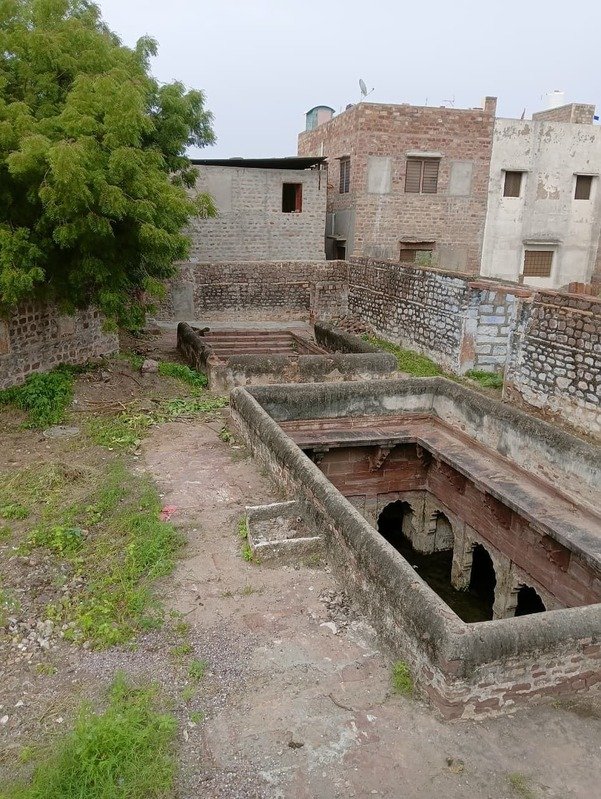
Temple in front, palace beside, water behind. The fabric of all three survives, unlisted, on a lane in the middle of the city. The palace courtyard still has its painted spandrels and figure panels, pierced jali screens over the openings, and the original panelled doors hung in their frames. Inside, the colonnaded veranda has paint still legible on the arches and jambs, with the floor and columns intact.
A domed chhatri stands on the terrace, its plaster weathered off the ribs but its columns and cusped arches sound. Against the compound wall is a carved sandstone stele with a mounted figure under a miniature shrine. A small stone lion was found loose on the steps during clearing; detached carved pieces stay on site.
What we found
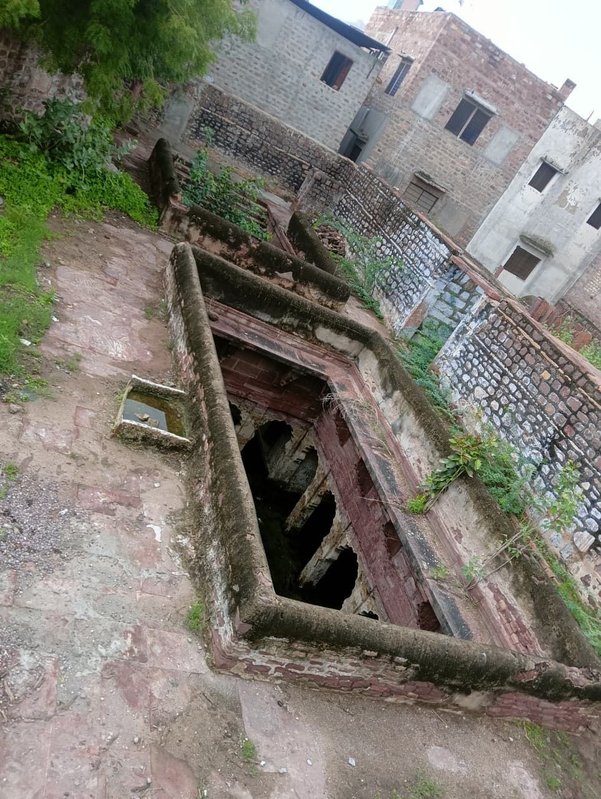
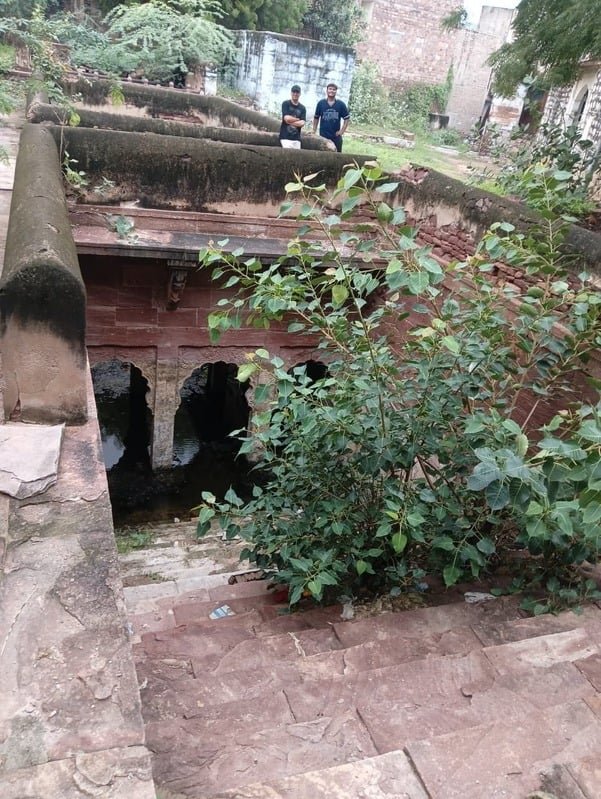
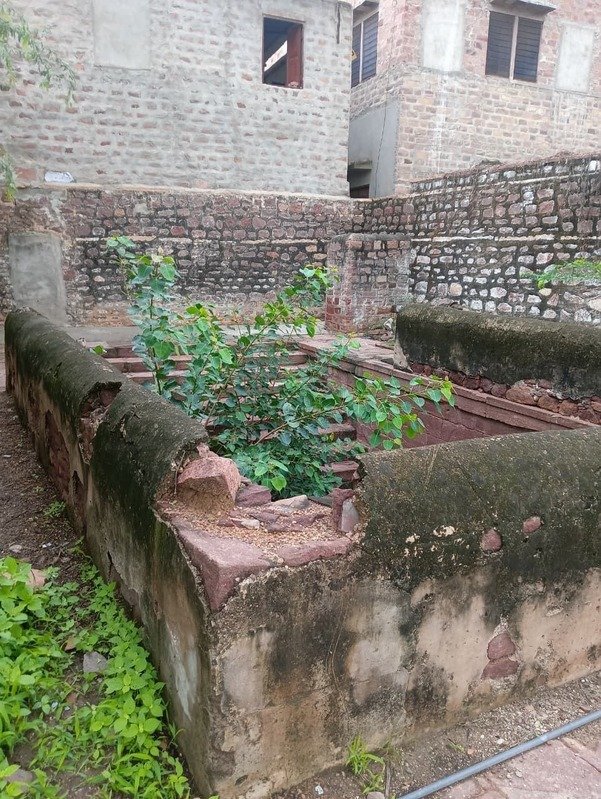
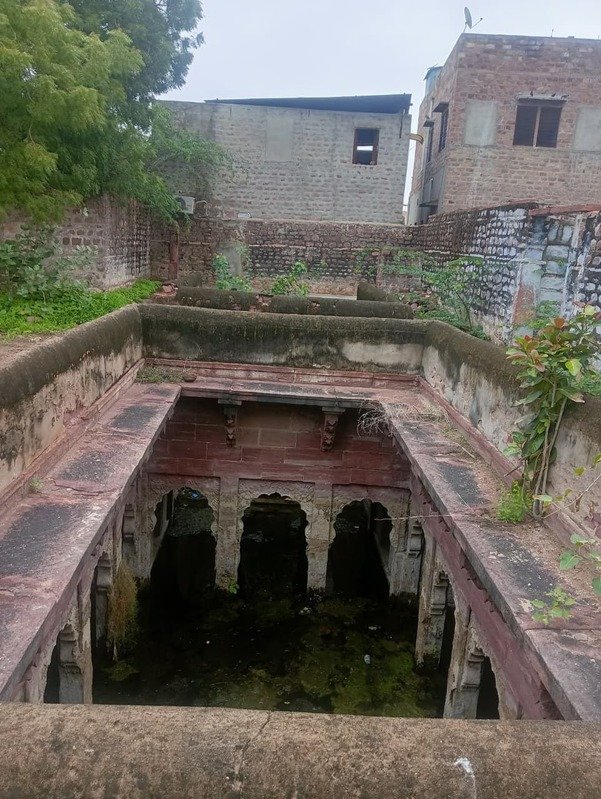
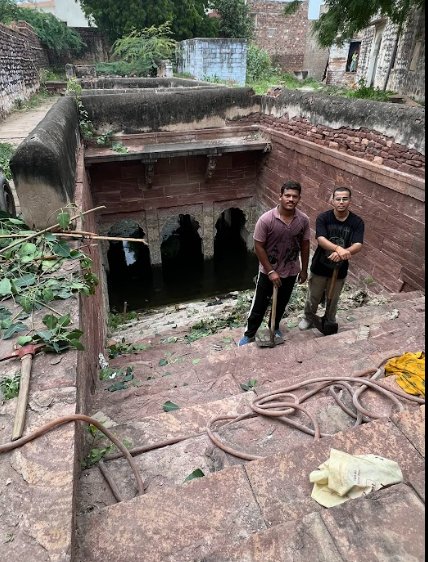
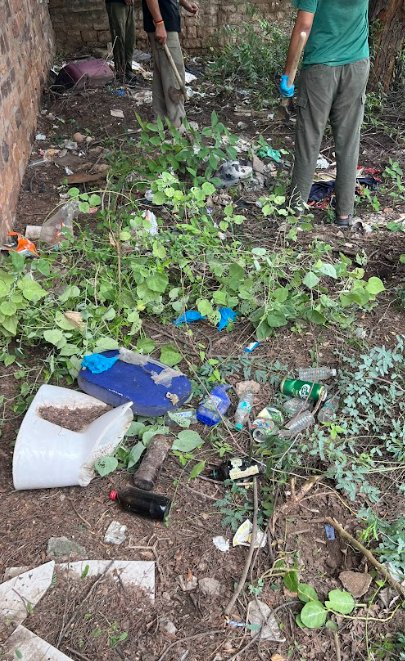
A full-grown tree stood in the mouth of the well, its canopy filling the shaft and closing the arcade below. Saplings and grass had rooted along the ledges and across the stepped runs on both sides. On the far wall, a shrub had rooted in the step run itself, creeper covered the coping, and the flight was impassable. Grass and scrub had spread over the parapet, with growth pushing out of the joints along the top course, hanging into the arcade and standing in the bed of the tank below.
Cut by hand, carried up the same steps it came down
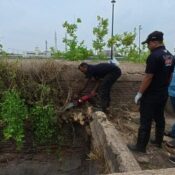
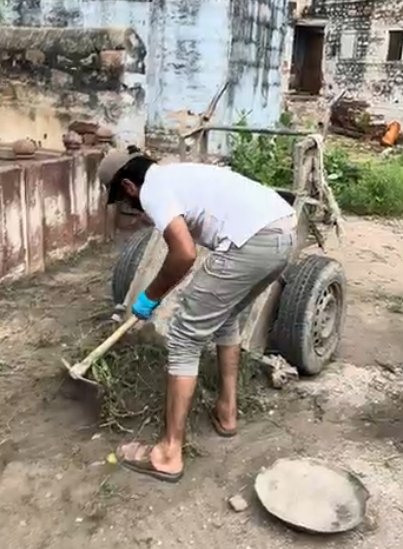
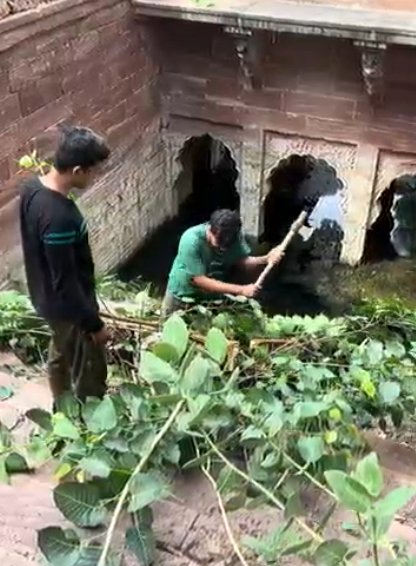
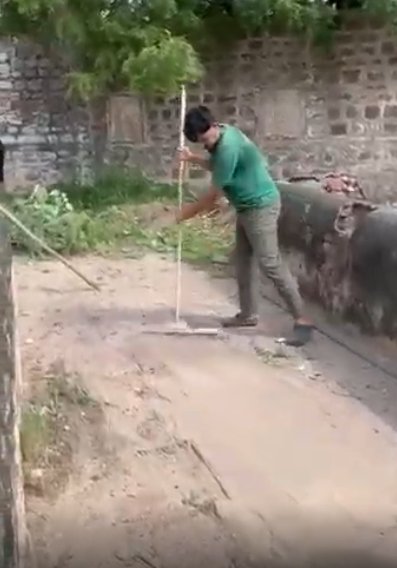
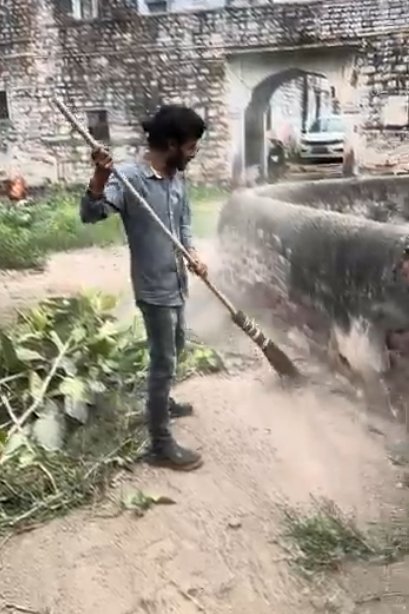
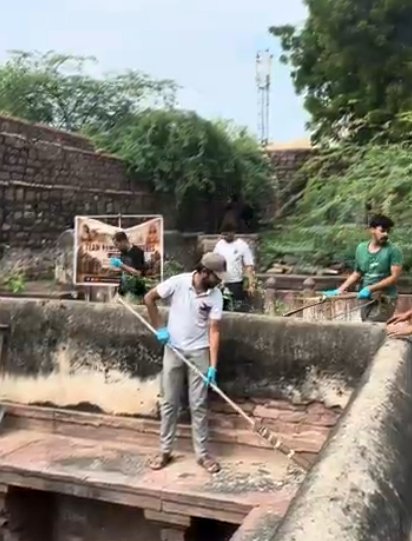
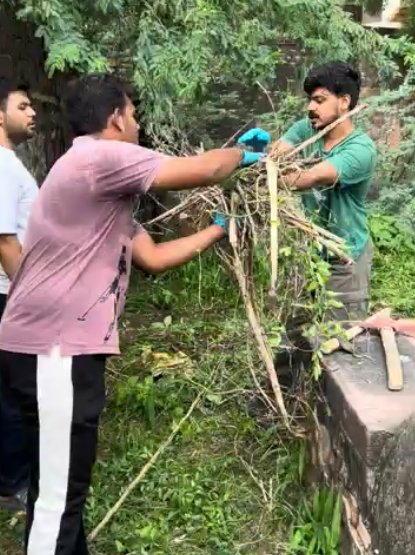
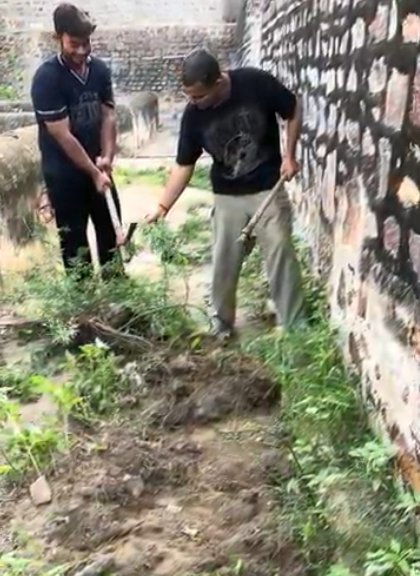
Rooted growth was cut back, waste was lifted out of the water and the beds, and everything was barrowed up to the road. Cut material was passed up over the parapet in armfuls, hand to hand, rather than dropped back in. Volunteers worked the ledge above the arcade, where roots had reached the joints, and took out roots at the base of the compound wall where they were opening the masonry.
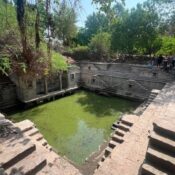
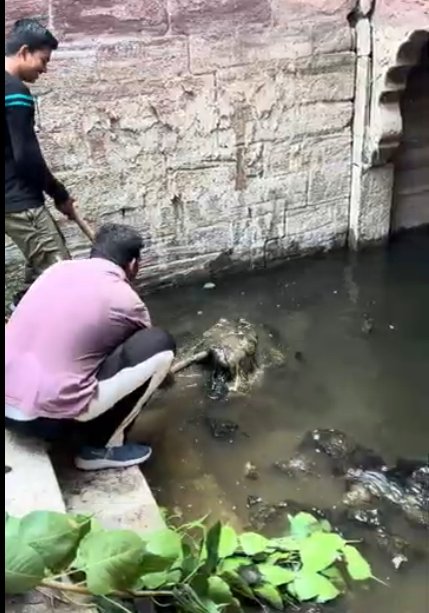
Floating growth was pulled off the water surface by hand from the ledge, and bottles, packaging and household plastic were lifted out of the beds around the tank. No machinery entered the structure and nothing was burned on site. Once the surface was open, volunteers went down to the bed of the tank, then came back up to wash and sweep the terrace and open the approach along the outer wall, so the well can be walked to from the lane.
What came back into view
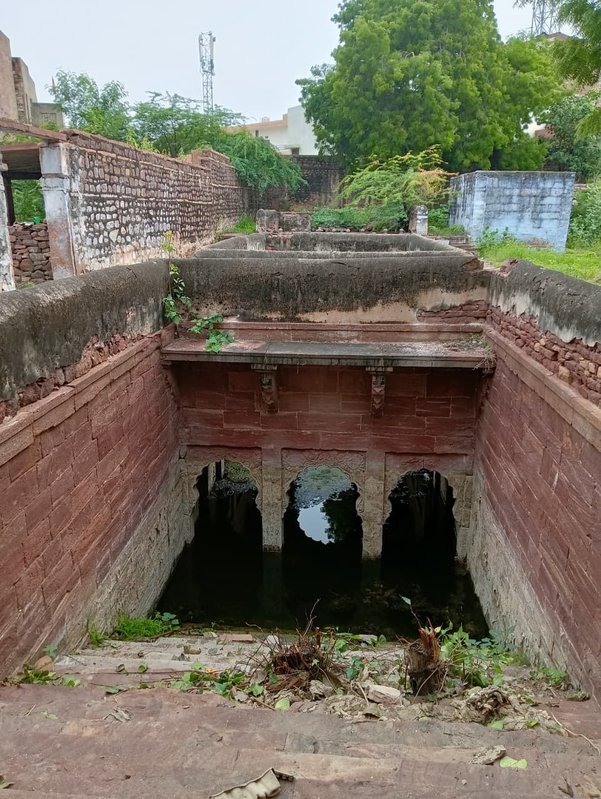
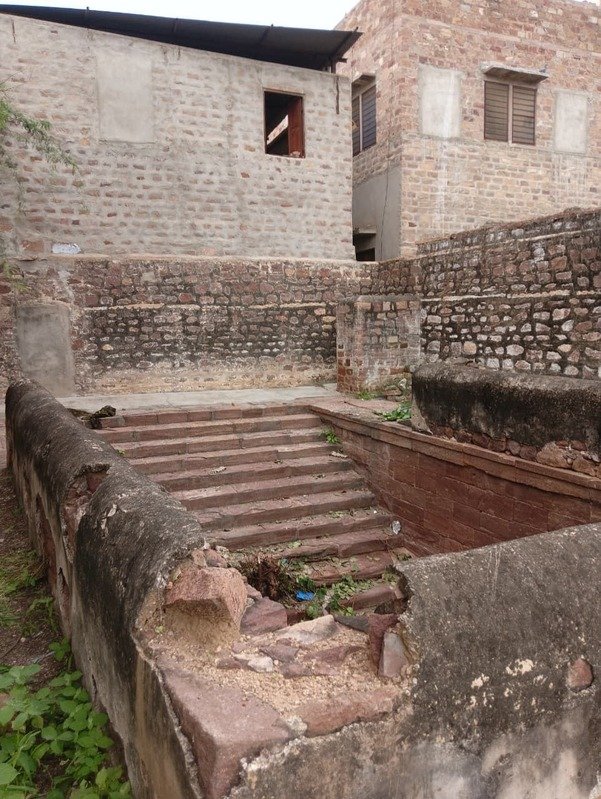
With the tree and undergrowth gone, the carved arcade, the bracketed cornice and the water surface are visible from the steps again. Straight down the shaft, the three cusped arches, their brackets and the full drop of the shaft are open to view. At the corner approach, the parapet line, the terrace and the flight down to the water read as one structure again. On the far wall, every tread is visible, the landing is swept, and the descent is usable from the terrace.
Twenty volunteers, Sunday after Sunday
The clearing ran across successive Sunday shramdaans by our volunteers, with residents of the lane joining in, until it was finished. Two Rajasthan papers, Rajasthan Aaj Tak and Too India News, carried the work and printed the number to call to join it.
At a glance
- Also called: Patal Phod Baori
- Location: Kila Road, Jodhpur, Rajasthan
- Built for: Pachwa Majisa, fifth wife of Maharaja Man Singh of Jodhpur
- Age (as reported in the press): c. 200 years
- Setting: Temple, palace and well, Kila Road
- Type: Baori, stepped well
- Status: Complete, unlisted
- Our work: Successive Sunday shramdaans, 2026
- Volunteers: 20 named in coverage
- Press: Rajasthan Aaj Tak, Too India News
No stone was moved. Everything here was simply taken off the building.